

In a Nutshell: What You Should Know
| – According to Google Search Central Live in Argentina 2026, SEO fundamentals still power AI search. Crawlability, indexation, helpful content, and strong site structure remain essential for visibility – even in AI-driven results. – Search is mutating with AI and multimodal experiences. Tools like Gemini, AI Overviews, Google Lens, and Circle to Search are expanding how users discover information. – High-quality, original content matters more than ever. To rank in both traditional search and AI systems, content must answer real user questions and offer unique value. |
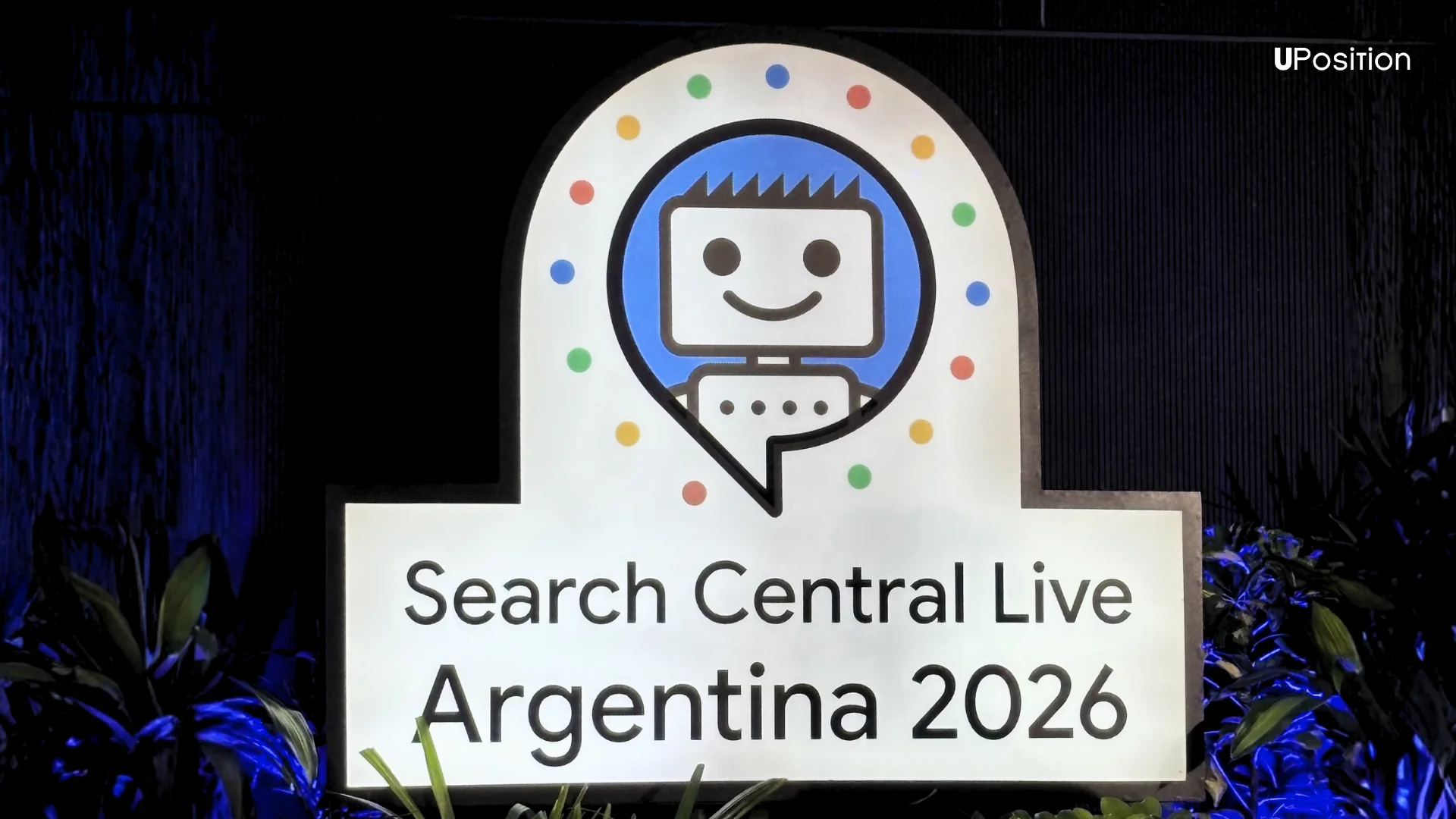
Google Search Central Live Argentina 2026 brought together professionals from across the digital ecosystem to explore the future of search, AI, and the web.
Held on February 26, 2026, the event featured talks from members of Google’s Search and Chrome teams, including Andre Nacul, Martin Splitt, Daniel Waisberg, John Mueller, Mari Viana, and Connie Niebuhr.
Their presentations covered topics such as AI-powered search, SEO fundamentals in the age of AI, new features in Google Search Console and Google Trends, AI capabilities in Chrome, and productivity with Gemini.
UPosition Agency was one of the few companies invited to attend the event, giving us the opportunity to hear these insights directly from Google!
Below is a recap of the key ideas and takeaways shared during the event. Read on to discover what Google revealed about the future of AI search and SEO!

1. Search in the Age of AI: Google’s Ranking Philosophy Still Starts With the User
The first presentation was delivered by Andre Nacul – Google Search Engineering Director, who discussed how Google Search is evolving in an ecosystem increasingly influenced by artificial intelligence.
One of the core messages of the talk was that Google’s ranking philosophy has remained remarkably consistent over time: the goal is always to provide the result that best helps the user.
Nacul explained how Google constantly runs experiments and updates its ranking systems to determine which pages most effectively answer a query. These improvements are not static – the search ecosystem is always evolving alongside technology and user behavior.
What works today might not work tomorrow, except for generating content that is unique and that is useful for the users.
– Andre Nacul, Google Search Engineering Director

Google’s Engineering Director also addressed common concerns about AI replacing traditional search. According to him, technological change has always sparked similar fears.
When the internet became popular, people believed radio would disappear. When Google launched, some believed books would become obsolete.
Neither prediction came true.

Instead, new technologies expand the ecosystem rather than replacing previous ones.
This philosophy is reflected in recent search innovations such as:
- Gemini
- AI Overviews
- AI Mode
These features exist because Google adapts to how users want to search today.
GEO/SEO is creating unique valuable content for people and providing a great page experience.
– Danny Sullivan, Search Director
2. Rethinking SEO Audits: Context Matters More Than Tools
The second presentation came from Martin Splitt – Google Search Advocate, who explored how Google Search works and how to conduct effective SEO audits.

Splitt highlighted a common issue in the SEO industry: overreliance on automated tools.
While technical tools can help identify potential issues, they should never replace a fundamental understanding of the website itself.

According to Splitt, every SEO audit should begin with three core pillars.

1. Understand the Website
Before analyzing metrics or errors, it’s essential to understand:
- what the website does
- its technical stack
- available engineering resources
- how the site is structured
Without this context, it’s impossible to evaluate issues correctly.
2. Identify Issues – But Validate Their Impact
SEO tools often highlight dozens of “errors,” but not all of them are meaningful.
Splitt gave a practical example: a website focused on hosting high-quality videos.
In that case, slower page speeds may be expected because the site intentionally delivers heavy media files. A warning about page speed might appear in a tool, but it may not represent a real problem for that business model.
The key lesson: context matters more than automated scoring systems.
3. Make Sense of the Data
The final step of an audit is prioritization.
Splitt encouraged teams to focus on:
- low-hanging fruit with high impact
- changes that can realistically be implemented
- decisions supported by real data

Different organizations also have different levels of resources. A large enterprise site and a small startup should not follow identical optimization priorities.

3. New Features in Search Console and Google Trends
Next, Daniel Waisberg – Google Search Advocate presented several new features in Google’s SEO and data analysis tools.

Query Groups in Search Console
A recently introduced feature in Google Search Console allows users to analyze performance by topic groups rather than individual queries.
Instead of reviewing isolated keywords, Search Console can now cluster related queries into thematic groups.
This aligns with how search works today: topics and intent often matter more than single keywords.

AI-Powered Configuration in Search Console
Another feature introduces AI assistance directly within Search Console reports.
Users can ask questions about performance data and receive AI-generated explanations and insights.
This capability makes Search Console more accessible to beginners while also speeding up analysis workflows.
Will AI Overviews Data Be Added to Google Search Console?
No, AI won’t be added to Google Search Console yet. But let us tell you why: Regarding Google Search Console, one of the questions that is frequently asked to the Google team is whether AI Overviews data will eventually be included in Search Console reports. During the event, this topic came up again, and Waisberg explained why Google has not yet added AI Overviews metrics to the platform:
Giving date to date data about AI Overviews on Google Search Console is not something we can guarantee will be helpful yet, as it changes constantly, and this is why we haven’t launched this feature. We don’t want you to make changes on your site based on data that is not good yet.
– Daniel Waisberg, Google Search Advocate
![How to Rank in AI Overviews – SEO Tips & Examples [2026]](https://i0.wp.com/upositionagency.com/wp-content/uploads/2025/05/how-to-rank-in-ai-overviews.webp?resize=600%2C600&ssl=1)
How to Rank in AI Overviews – SEO Tips & Examples [2026]
AI Overviews are concise summaries generated by Google to enhance search visibility and user trust. To rank in these overviews, content must be optimized through structured data and clear answers, addressing user intent. Engaging with UPosition Agency can help improve SEO strategies tailored for AI-driven searches and increase website traffic.
Keep reading ‣Google Trends API Alpha
Waisberg also introduced a new API for Google Trends. The API allows analysts and developers to access trends data programmatically, making it possible to build custom dashboards, visualizations, and automated analyses based on search interest.
Instead of manually exploring data inside the Google Trends interface, teams can use the API to extract historical search trends, compare keywords at scale, and integrate trends data into their own tools or reporting workflows.

Trends Explore with Gemini
Google Trends is also integrating AI through Gemini, introducing a feature called Trends Explore with Gemini.
This capability allows users to explore search trends by asking questions directly to the AI, instead of manually navigating charts and filters inside the platform.
With Gemini, users can request insights such as:
- emerging topics related to a keyword
- comparisons between search trends
- explanations of changes in search interest over time
The AI can analyze the available trends data and generate contextual explanations and summaries, making the research process faster and easier to interpret.
This feature is particularly helpful for beginners or non-technical users, as it simplifies trend analysis and allows them to extract insights without needing deep experience with the Google Trends interface.
4. John Mueller’s SEO Notes: Content Still Wins
One of the most anticipated talks was delivered by John Mueller, Google Search Advocate & Search Relations Team Lead. Mueller shared several insights about the evolution of search and the continued importance of SEO fundamentals.
💡 One striking statistic he mentioned: Around 15% of searches performed on Google every day have never been searched before.
This highlights the constantly expanding nature of search behavior and the ongoing opportunity for organic visibility.

Search Is Becoming Multimodal
John Mueller also explained that search is no longer limited to typing a query into a search box. As technology evolves, Google is expanding the ways users can discover information through multimodal search experiences.
Today, users can interact with search using a combination of text, images, and visual context.
Some of the examples mentioned include:
- Circle to Search, which allows users to search directly from their smartphone screen by circling an object or piece of content.
- Google Lens, which lets users search using images captured with their camera or screenshots.
- Multimodal search, where users combine text and images in the same query to get more precise results.
These experiences reflect a broader shift in how people interact with search engines. Instead of relying only on written queries, users increasingly search based on visual context, real-world objects, or mixed inputs.
Mueller also discussed a feature called Web Guide, where AI organizes search results into structured sections. Instead of presenting a simple list of links, Web Guide groups results by topic and provides short summaries for each category, along with links to relevant pages.
This approach helps users explore complex topics more easily by structuring information into clear thematic sections.
Instead of trying to work back how Google’s algorithms might be working, I would recommend trying to figure out what your users are actually thinking.
– John Muller, Google Search Advocate & Search Relations Team Lead
The Rise of Creator Content in Search
Another important trend highlighted during the talk is the increasing visibility of creator-driven content within search results.
Google is progressively surfacing content from creators across social platforms directly within the search experience.
Depending on the query, search results may highlight content from:
- Instagram creators
- YouTube Shorts videos
- TikTok videos
- posts from X (Twitter)
This reflects a shift toward more dynamic, multimedia search results, where traditional web pages coexist with short-form video and social content.
For content creators and brands, this means that visibility in search is no longer limited to websites. Video content and social media presence are becoming increasingly important signals within the broader search ecosystem.

“Focus on Your Awesomeness”
Another key message from Mueller’s talk was the importance of content quality as the foundation of search visibility.
Despite the rapid evolution of AI-powered search experiences, Mueller emphasized that the core principle behind ranking has not changed: help users find the most useful information.
His advice to website owners and content creators was simple: Focus on what makes your content uniquely valuable.
Make sure you add something to the conversation. If you are having the same facts that everyone else has, you’re one out of many, so there’s higher competition to begin with. But if you have some information that is unique, it’s both appreciated by users and search engines.
– Martin Splitt, Google Search Advocate
Effective content should:
- answer real user questions clearly
- provide original perspectives or expertise
- add meaningful value beyond what already exists online
In other words, simply repeating information that can already be found across dozens of other websites is unlikely to perform well in search results.
As search engines become better at understanding information and identifying patterns across the web, originality and real expertise become increasingly important signals of quality.

SEO and AI Search Share the Same Foundations
Mueller also addressed a question many site owners & creators have today: how AI-generated search experiences affect traditional SEO.
According to him, the fundamentals of SEO are still critical because AI systems often rely on search engines to retrieve reliable sources of information.

In simplified terms, many large language model systems operate in a process similar to this:
- The system receives a user question.
- It queries search engines to retrieve relevant content.
- It gathers and analyzes multiple sources.
- It may generate additional related queries (often called fan-out queries).
- It produces a response grounded in those sources.
Because of this process, websites still need to follow the same foundational principles that have always supported search visibility.
For content to be discoverable and usable by both search engines and AI systems, websites must ensure:
- proper indexing, so pages can appear in search results
- crawlable architecture, allowing search engines to access the content
- useful and relevant information, aligned with user intent
- a good user experience, making the content easy to navigate and understand
In other words, while the interface of search may be changing, the underlying signals that make content discoverable remain largely the same.

To finalize his talk, Mueller also shared a few practical writing tips for content in the age of AI, referencing recommendations commonly mentioned by technical writers.
Some of the key guidelines he highlighted included:
- Keep writing simple and focused. Avoid long paragraphs and overly complex sentences. Use clear, easy-to-understand language.
- Remove contradictions in lists. When presenting “don’t” lists, clearly mark them as negative recommendations to avoid confusion.
- Avoid unnecessary historical explanations. Focus on the present recommendation instead of long contextual stories.
- Avoid hidden or conditional content, such as expandable tabs or sections that require user interaction to reveal important information.
- Include images and videos with supporting text, rather than relying only on alt-text for context.
These recommendations aim to make content easier to interpret for both users and AI systems, improving clarity, accessibility, and overall discoverability.

5. AI Is Moving Into the Browser
The next session, presented by Mari Viana – Chrome Solutions Engeneer, explored how artificial intelligence capabilities are beginning to be integrated directly into the browser through new Chrome technologies.
One of the central concepts introduced during the talk was Client-Side AI.
Traditionally, most AI applications rely on cloud-based APIs, where requests are sent to external servers for processing. However, Chrome is moving toward a model where certain AI capabilities can run locally on the user’s device, directly within the browser.
By leveraging the device’s hardware, including CPU, GPU, or dedicated AI processors, Chrome can execute certain AI tasks without needing to constantly communicate with remote servers.
This approach offers several advantages:
- Improved privacy, since sensitive data does not always need to leave the user’s device
- Lower latency, allowing faster responses because the processing happens locally
- Reduced infrastructure costs, as fewer requests need to be handled by cloud servers
- Offline capabilities, enabling certain AI-powered features to work even without an internet connection
To support this shift, Chrome is introducing a set of built-in AI APIs that developers can use directly in web applications.

Some of the APIs mentioned during the presentation include:
- Prompt API, which allows developers to send prompts to local AI models running within the browser
- Summarizer API, designed to generate summaries of text content
- Translator API, enabling on-device language translation
- Language Detector API, which automatically identifies the language of a piece of text
- Writer API, used for generating or assisting with text creation
- Rewriter API, which can modify existing text by adjusting tone, format, or length
📌 These APIs open the door for developers to build AI-powered features directly into websites and web applications, without relying entirely on third-party AI services.
The presentation also introduced DevTools MCP, a capability that allows AI assistants to interact with Chrome DevTools. This enables developers to use AI to analyze code, detect potential issues, suggest fixes, and assist with debugging processes.
Together, these developments point toward a broader vision for the web: a more intelligent browser environment where AI becomes a built-in capability of the platform itself, rather than something accessed only through external tools or services.
6. Productivity With Gemini
The final presentation was delivered by Connie Neighbor – Google News Partner Manager, who focused on how professionals can use Gemini more effectively in their daily workflows.
Her central message was clear: the quality of AI outputs depends heavily on how prompts are designed.

Instead of treating AI tools like a search engine where users simply ask a quick question, Neighbor explained that better results come from providing clear structure and context when interacting with the model.
According to her, a well-designed prompt should include several key elements:
- The role the AI should adopt (for example, a data analyst, or a product manager)
- The specific task the AI should perform
- The output format expected (such as a list, summary, report, or table)
- The intended audience, which helps guide tone and complexity
- Context or constraints, such as word limits, style guidelines, or specific goals
By structuring prompts in this way, users can guide the model more effectively and obtain clearer, more relevant responses.
Best Practices for Working With AI
Neighbor also shared several practical techniques for improving productivity when working with AI systems.
One important recommendation was to break complex tasks into multiple steps rather than asking the model to complete everything at once. Dividing the workflow into smaller tasks often produces more accurate and useful results.
Another useful strategy is to ask the AI to clarify questions before generating an answer. This allows the system to verify that it fully understands the objective before producing a response.
Gemini can also be used to review existing content, analyze documents, or interpret reports, acting as an assistant that helps professionals process large amounts of information more efficiently.
She also discussed a capability called Deep Research, where Gemini can analyze multiple sources across the web and compile them into a structured report on a specific topic. In addition, users can configure Gemini to generate recurring research updates, allowing them to stay informed about developments or trends within a particular field.
Prototyping Ideas With Gemini Canvas
Another interesting capability mentioned during the presentation was Gemini Canvas.
This tool allows users to create UI prototypes simply by describing an idea, without needing any programming knowledge. By providing a prompt that explains the concept of a product or interface, Gemini can generate a visual prototype that helps illustrate how the idea might work.
For product teams, this can significantly speed up early-stage ideation. Instead of waiting for a full design or development process, teams can quickly visualize concepts, test ideas, and iterate on interface designs using AI-assisted prototypes.
Together, these capabilities highlight how tools like Gemini are not only transforming search and research workflows, but also changing how professionals brainstorm, analyze information, and build digital products.

What These Changes Mean for SEO: Insights from UPosition
One of the most valuable aspects of attending Google Search Central Live Argentina 2026 was hearing directly from Google’s teams about how search is evolving in the age of AI.
UPosition Agency was one of the few companies invited to participate in the event, giving our team the opportunity to gain first-hand insights from Google’s Search and Chrome teams and better understand how these changes will impact the future of organic visibility.
A key takeaway from the event is that while search interfaces are evolving quickly with tools like Gemini, AI Overviews, and multimodal search, the foundations of SEO remain largely the same. High-quality content, strong technical infrastructure, clear site architecture, and helpful user experiences continue to play a critical role in how information is discovered and surfaced.
At the same time, AI is becoming an integral part of how search engines process information and how users interact with content. This means that SEO strategies must increasingly consider both traditional search systems and AI-driven discovery experiences.
For UPosition, the insights shared during the event reinforce the direction we are already taking with our work: combining strong SEO fundamentals with an understanding of how AI systems retrieve, interpret, and surface information.As search continues to evolve, the future will not be SEO or AI – it will be SEO and AI working together. And helping companies navigate that intersection is becoming one of the most important challenges for modern digital strategies.

Yael Fan Mosqueda – CEO & Founder, UPosition Agency
Related Articles
![How to Rank in AI Overviews – SEO Tips & Examples [2026]](https://i0.wp.com/upositionagency.com/wp-content/uploads/2025/05/how-to-rank-in-ai-overviews.webp?resize=800%2C600&ssl=1)
How to Rank in AI Overviews – SEO Tips & Examples [2026]
AI Overviews are concise summaries generated by Google to enhance search visibility and user trust. To rank in these overviews, content must be optimized through structured data and clear answers, addressing user intent. Engaging with UPosition Agency can help improve SEO strategies tailored for AI-driven searches and increase website traffic.
Keep reading ‣
Apple AI News: How Google Gemini in Siri Impacts Your SEO in 2026
Apple and Google have partnered to enhance Siri’s AI capabilities, enabling quicker, more complete responses to user queries. As users rely less on multiple search results, brands must optimize content for AI verification and clarity. UPosition offers strategies for improving visibility in both traditional search and AI-generated results, adapting to these evolving behaviors.
Keep reading ‣![10 AISO or AI Search Optimization Best Practices [Easy Guide 2026]](https://i0.wp.com/upositionagency.com/wp-content/uploads/2025/10/aiso.webp?resize=800%2C600&ssl=1)
10 AISO or AI Search Optimization Best Practices [Easy Guide 2026]
AI Search Optimization (AISO) enhances SEO by focusing on semantic relevance, user intent, and authority signals, allowing brands to improve visibility in AI-driven search results. Companies utilizing AISO benefit from higher traffic, better conversion rates, and adaptability to algorithm changes. Partnering with experts like UPosition can streamline this process effectively.
Keep reading ‣
Leave a Reply